
Our UTM cohort cities are not just participants in the transition, they are driving it as true solution providers. By committing to net-zero pathways, the UTM cities transform into innovation hubs testing, refining, and sharing the definitive blueprints for the sustainable cities of tomorrow.
We close the implementation gap.
UTM helps cities to bridge the gap between ambitious climate goals and practical implementation by focusing on three core pillars:
UTM cities are committed to engage and serve as a solution provider to support net-zero pathways, inspire others and share solutions. UTM serves as a catalyst and facilitates this journey. We broker access to knowledge and training and connect our cities with innovative technical, regulatory and financial solutions, ensuring they don’t just plan innovation – they experience it first-hand.
The term “pilot action” for UTM refers to a small-scale initiative designed to test a new technology, solutions, or approach tackling urban challenges across sectors. All UTM pilot actions are implemented in and by UTM cities, in collaboration with members of the Global Innovation Alliance and private sector partners. The model of direct engagement applied by UTM, bringing together cities and the private sector – brokering specific areas/solutions for piloting, through testing and applying services and solutions free of charge – is both unique and very successful: learnings on partnerships models, business models, as well as results from these cooperations will be widely disseminated, and exploited to scale up the pilots and facilitate private investments.
We use a powerful data-driven approach to match a city’s specific needs with proven solutions, launching what we call “Pilot Actions” – real-world testing grounds for cutting-edge technology.
Based on our intensive assessment carried out with our cohort of 145 cities, UTM directly connects identified needs and challenges of UTM cities with solutions and approaches able to support the implementation of their net-zero pathways.
To create Pilot Actions, UTM identifies and facilitates opportunities for cities to work with individual Global Innovation Alliance members, private sector partners, and other Missions specifically to co-develop the solutions that matter:
Bespoke support: Technical assistance and support tailored for complex urban transitions.
Safe-to-Test Environments: Regulatory sandboxes where new policies and frameworks can be safely tested.
Capital pathways: Investment and funding strategies to secure the capital necessary for infrastructure.
Digital power: Access to advanced solutions, data, and digital tools to scale advanced services to monitor and accelerate progress.
Innovation hotspot: The chance to become the testing ground for ground breaking technologies and solutions developed in the framework of Mission Innovation.
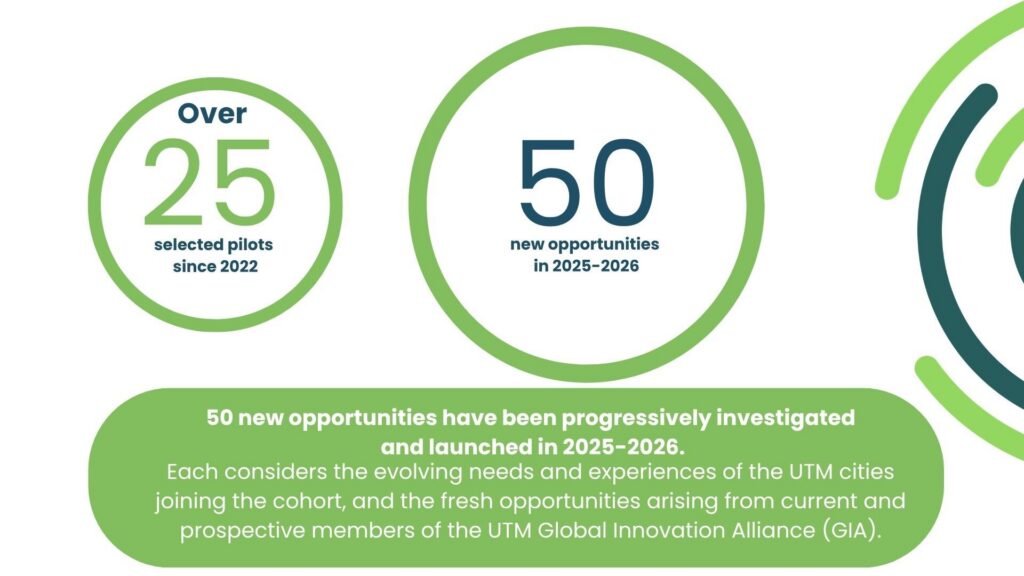
Pilot Actions in numbers
Over 25 selected pilot and assistance opportunities have already been identified since 2022.
50 new opportunities have been progressively investigated and launched in 2025-2026.
Each considers the evolving needs and experiences of the UTM cities joining the cohort, and the fresh opportunities arising from current and prospective members of the UTM Global Innovation Alliance (GIA).
We are committed to co-developing and piloting up to 50 innovative technological, regulatory, and socio-economic solutions. To achieve this, the UTM actively identifies synergies and forges concrete collaboration agreements between researchers, universities, practitioners, and city governments, in line with cities’ needs.
Pilots respond to the following macro-priorities and needs:
100% and decentralized Renewable Energy Generation & Technologies
Innovative applications of solar technology solutions are being developed and tested to support cities in accelerating and scaling solar energy deployment in Kisumu County (Kenya) and Yancheng (China). This partnership with the Institute of Earth Environment, Chinese Academy of Science (IEECAS) is geared to support cities to plan, accelerate and scale solar energy deployment. It includes the development of a dedicated software currently being tested in Yancheng to help cities plan and assess the best location and type of solar PV for their needs. .
County Kisumu will host the first implementation teaming with IEECAS to identify innovative PV planning solutions and cutting-edge technology designed to support urban energy planning – other international cities are going to be considered for future replication.
Partner: Institute of Earth Environment, Chinese Academy of Science (IEECAS)
This collaboration combines technical planning, investment facilitation, and community-led design all in service of Kisumu County’s ambitious roadmap to 100% RES energy. Mission Innovation’s Green Powered Future Mission (GPFM) will be looking into the upscaling RES in local grids, in particular focusing on the integration and strengthening of EV charging infrastructure.
Partner: Mission Innovation’s Green Powered Future Mission (GPFM)
UTM, in collaboration with ICLEI South America and Brazil’s Energy Research Office, is engaging with Abaetetuba (Brazil) to scale RES generation on isolated public buildings. The Green Powered Future Mission (GPFM) provides mainly technical advice on scaling up decentralised PV of public buildings such as schools, community centres or clinics in remote locations. The pilot might also explore e-charging infrastructure related to e-boats used for public transport to such remote locations.
Partners: Mission Innovation’s Green Powered Future Mission (GPFM), ICLEI South America, Brazil’s Energy Research Office.
Net-Zero Buildings, Housing & Smart energy planning
Through a collaboration with KPMG, UTM facilitated the development of a digital twin in Greater Manchester (UK) which integrates real-time data from the city’s infrastructure, including housing tenure, building energy use, retrofit potential, and heating systems. This virtual model enables city planners and energy managers to simulate different decarbonization scenarios, assess the impact of interventions, and prioritize investments in energy efficiency and renewable energy.
Partner: KPMG Net Zero Urban Program
Mobility, Electric Vehicles, Grid & Storage
A free prototype software was co-developed in partnership with six cities – Belo Horizonte (Brazil), Zhytomyr (Ukraine), Cascais (Portugal), Renca (Chile), Penalolen (Chile), Greater Amman (Jordan)- to help them plan and optimize the location of bike lanes to provide school access, considering planning, traffic, meteorological situations such as extreme heat risk, and tree coverage. In the framework of the X-Creation innovation process hosted by T-System, UTM undertook the role of challenge leader, in collaboration with data solution provider DKSR, for the creation of digital solutions able to support cities with their urban planning and mobility needs. Cities participated in exchange sessions and short interviews to share their context, needs, requirements and priorities. A pay for extended version will be made available for other cities interested.
Partner: T-Systems
A free prototype software was co-developed in partnership with six cities – Belo Horizonte (Brazil), Zhytomyr (Ukraine), Cascais (Portugal), Renca (Chile), Penalolen (Chile), Greater Amman (Jordan)- to help them plan and optimize the location of bike lanes to provide school access, considering planning, traffic, meteorological situations such as extreme heat risk, and tree coverage. In the framework of the X-Creation innovation process hosted by T-System, UTM undertook the role of challenge leader, in collaboration with data solution provider DKSR, for the creation of digital solutions able to support cities with their urban planning and mobility needs. Cities participated in exchange sessions and short interviews to share their context, needs, requirements and priorities. A pay for extended version will be made available for other cities interested.
Partner: T-Systems
Resilience Planning, NbS & Technologies
Supporting the city of Greater Manchester (UK) with resources and support for the development of a comprehensive cooling strategy, including active measures for citizens engagement and protection as well as mapping of impacts and guidelines for tackling urban heat island effect.
Greater Manchester’s cooling strategy is integrated into its broader Five-Year Environment Plan (2025–2030) and Manchester Climate Ready (MCR) Plan 2025-2030, aimed at achieving carbon neutrality by 2038.
Partner: UK Government
Through this collaboration a digital twin was developed for the city of Belo Horizonte (Brazil), to help the city tackle the local urban heat island effect. UTM connected the winner of the 2024 AIxCities Hackathon the ETH Centre with the city of Belo Horizonte to receive support and pilot the innovative award-winning solution. The solution mapped temperature variations, land use, green cover and heat-related health risks in a comprehensive interactive Heat Map with a 2 meters accuracy for the city area of Belo Horizonte. The digital twin enables city officials to assess the effectiveness of nature-based solutions, such as tree planting or green roofing, before physical implementation.
Partner: Innovate4Cities – AIxCities Hackathon’s partner Singapore ETH Centre
The pilot project defining cascading and systematic risks for water and energy infrastructure in central Greater Amman (Jordan) uses Tipping Frontiers software to provide accurate risk considerations and potentially lower the costs of financing.
Partner: Tipping Frontiers
Data-driven management, Tools & Digital Solutions
Through a partnership with Google Environmental Insights Explorer (EIE), ten UTM cities – Cascais (Portugal), Lappeeranta (Finland), Greater Manchester (UK), Konotop (Ukraine), Belo Horizonte (Brazil), Aarhus (Denmark), Antalya (Turkey), Miami-Dade (USA), Puerto Montt (Chile), Renca (Chile) received tsup[port to access insights and manage data and information for local data-driven planning.. Based on hands-on workshops and interviews, UTM provided UTM cities with guidance on the use of mobility insights for sustainable urban mobility planning. Cities explored access, storage, management and possible use of local and EIE hosted data, its complementarity and use for verification purposes.
UTM, in collaboration with Google, developed three guides to assist cities in the design of transport and mobility strategies, in the strengthening, and implementation of evidence-based urban planning and investment strategies by using Google’s Environmental Insights Explorer (EIE) data to drive informed decision-making. The guide “Urban Transition Mission & Environmental Insights Explorer Join Forces: Data and Insights to Inform, Action and Monitor Local Mobility Policies,” aims to help cities of the UTM cohort have easy and guided access to Google’s EIE platform, leveraging its available tools, visualizations, and data sources.
Other guides include: ‘Transforming the future of Urban Planning with data and insights’ and ‘Data & Insights to accelerate impact finance and de-risk investments in cities‘.
Partner: Google
Selected cities – Renca, Peñalolén, Puerto Montt (Chile), Rosario, Buenos Aires (Argentina) – received support through the OpenEarth CityCatalyst AI-driven Tool and GIS-based support interface, as well as identification of action and GHG monitoring through the modeling and the enhanced completeness of their inventories.
Partner: Open Earth
Global Innovation Alliance member GeSI has been working with UTM city Braga (Portugal) on the reduction of energy consumption in public buildings and options for the roll out of an electric e-vehicles fleet to ensure enhanced comfort for citizens and reduced energy costs and emissions for the city.
Bankability, Blended Finance vehicles & Green Bonds
Global Infrastructure Basel (GIB) is a Swiss Foundation focusing on unlocking financing opportunities for sustainable infrastructures projects. UTM City Penalolen was guided in the submission of two projects in the GIB platform ahead of their pitching event in 2023: one regarding the development of the Parque Quebrada de Macul, and another focused on municipal water management
As broker of solutions, UTM, in collaboration with the Urban Transitions Mission Centre (UTMC) and its Helpdesk for Financing & Funding, worked to identify specific technical assistance support for mature city projects within the cohort. By collaborating with the GAP Fund Support team, UTM cities were able to successfully apply for the Fund technical assistance. Ad hoc introductory workshops have been carried out with cities in Albania, Argentina to foster their application to the fund. Technical assistance for early project preparation was offered to five cities in Albania, including three non-UTM cities under the collaboration agreement with the EU & Global Mission Center operating as a platform for Albania within the framework of the EU-funded CAPACITIES project. The following UTM cities have benefited from the Cities Climate GAP Fund support so far:
Villa Maria (Argentina), Mat, Liberhaz (Albania) , Darkhan (Mongolia) in 2023 and 2024.
(2024) Bodo (Norway), Rosario, Avellaneda (Argentina), Poti (Georgia), Penaloen, Renca, Puerto Montt, Vitacura (Chile) Cartagena de Indias (Colombia), Belo Horizonte (Brazil), Cuenca (Ecuador), Darkhan (Mongolia), Baguio (Philippines), Quelimane (Mozambique)
(2025) Vitacura, Puerto Montt (Chile), Avellaneda (Argentina) Poti (Georgia) : following the launch of the 2025 ICLEI TAP Call, collaboration has been carried out to support pitching of project concepts to funders. As a result, 4 cities have presented their projects in TAP in 2025.
Greater Manchester (UK), Paris (France), Cascais (Portugal): In collaboration with Cities TCP and the International Energy Agency (IEA) selected cities have been engaged and supported in exploring suitable options and innovative blended finance solutions including blended finance vehicles/SPVs aimed at supporting the decarbonisation of the city, including Scope 2 emissions and private sector.
A workshop has been carried out online, co-organised by the IEA, with the participation of European Investment Bank (EIB), European bank for Reconstruction and Development (EBRD) and the World Bank, among the speakers.
Participation in the X-Creation 2025 challenge as challenge owner in the urban solutions category. Via a collaboration with T-Systems and Deutsche Borse, UTM has developed a concept for supporting cities in accessing blended finance UTM has developed a concept for supporting cities in accessing blended finance via the issuance of green and sustainability-linked bonds with pilot cities still being identified.
Sustainable Integrated Lighting
In 2024, as part of the Global Innovation Summit, a selected number of cities had the opportunity to join the Study Tour at Signify’s Outdoor Lighting Application Center (OLAC) which provided them with a practical exploration of how innovative outdoor lighting solutions can support cities’ decarbonization efforts, while enhancing safety and well-being and safeguarding circularity and biodiversity needs. Hosted by Signify, in collaboration with UTM, the Study tour provided participants with a practical exploration of how innovative outdoor lighting solutions can support cities’ decarbonization efforts.
During the workshop, facilitated by Signify experts, attendees focused on identifying key topics of interest, sharing best practices and solutions already implemented or planned, and collaboratively drafting a high-level plan to address these challenges.
The following UTM cities benefited from the tour: (2024)- Ahmedabad (India), Mumbai (India), Baguio (the Philippines), Istanbul (Turkey), Renca (Chile), Antalya (Turkey), Cocody (Ivory Coast), Lappeeranta (Finland).
In 2025, the Urban Transitions Mission, the Global Covenant of Mayors for Climate & Energy (GCoM), and Signify released an urban lighting survey, aiming to assess the current global state of lighting infrastructure in cities, identify gaps, and provide recommendations for improvement. Insights gathered contributed to policy development and support cities on their journey toward low-carbon, climate-resilient infrastructure. Cities respondents to the survey were eligible to benefit from technical assistance from Signify in the form of a free audit service offered by Signify.
This service helped to provide a detailed analysis of a city’s existing lighting infrastructure and tailored guidance on how to improve it. The audit was not binding to any commercial agreement. The content and the scope of the audit was mutually decided and agreed between the City and Signify.
The following cities benefited from this cooperation and lighting audits offered by Signify in 2025: Baguio (Philippines), Sheki (Azerbaijan) , Poti (Georgia), Al-Muwaqqar (Jordan), Antalya, Çorlu TR, Khmelnytskyi, Vinnytsia , Zhytomyr (Ukraine), Bălți, Strășeni (Moldova), Cocody (Ivory Coast)I, Abelkuma, Sekondi-Takoradi (Ghana), Belo Horizonte (Brazil), Peñalolén (Chile), Cuenca (Ecuador) and Miami-Dade (US).
Partner: Signify
Holistic transitions , public participation and social inclusion
The following UTM cities, Kochi (India), Patna (India), Greater Manchester (UK), Lappeeranta (Finland), Lujan de Cujo (Argentina), Miami-Dade (US), Belo Horizonte (Brazil), Puerto Montt (Chile), Renca (Chile), Chefchaouen (Morocco), Zhytomyr (Ukraine), Vitoria-Gasteiz (Spain) were engaged in the activities of the UNFCCC Global Innovation Hub. The collaboration pilot connects city administrators with solution providers, investors, financial institutions and academia with cities participating in international workshops to present their specific net-zero challenges and visions, and identify practical solutions to address core human needs like access to energy, mobility, and shelter).
Global Innovation Alliance member ENoLL offered the possibility for 4 UTM city representatives to attend free of charge the Virtual Learning Lab (VLL) training course organized by the association for its members. Antalya (Türkiye) joined in the course starting in April 2024, Cascais and Zhytomyr (Ukraine)that started in October of the same year. The course spanned over 10 weeks, guiding cities through key components of Living Labs and equipping them with knowledge and tools to successfully run Living Labs in their community. Here are more details on one Virtual Learning Lab.
The Doughnut Economic Action Lab (DEAL)principles can help the city make its strategy and vision more holistic, as well as support on its impact assessment, and the creation of a new narrative to engage local stakeholders. In this pilot, experts of the DEAL help cities to use and apply the Doughnut Economics to their city vision. Including 1-1 introductory and strategic calls, input on material drafted by cities, and availability of DEAL’s experts as “open-door strategic friends” to help the city in its evolving work. Cities are invited to engage free of charge and exchange with peers through regular workshops with the DEAL community. Since 2023, the following cities have benefited of this engagement: Cocody (Ivory Coast), Vitoria-Gesteiz (Spain), Peñalolén (Chile), Baguio (the Philippines), Menjez (Lebanon)
Partner: Doughnut Economic Action Lab (DEAL)