Date: March 5, 2026
Time: 13:30-15:00 CET/UTC+1
The event has already happened: recording and presentation
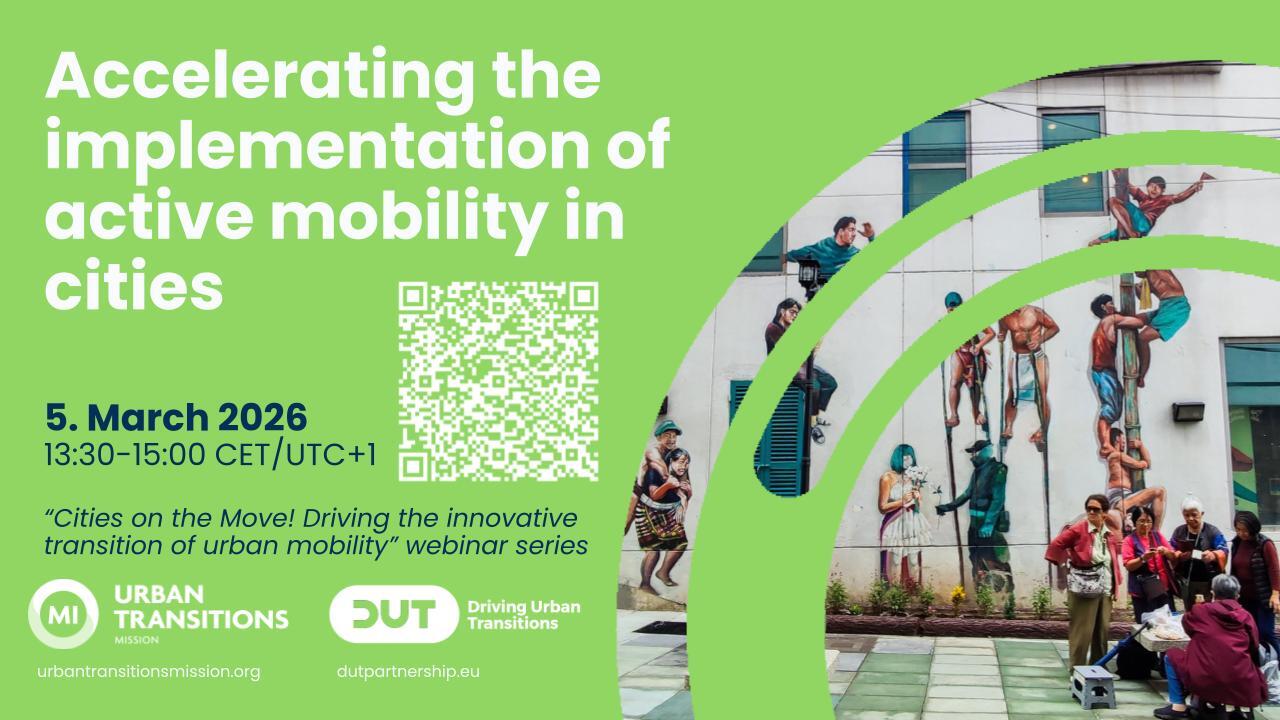
While active mobility offers significant benefits to urban residents, cities often lack adequate infrastructure, political will and public acceptance to prioritise walking and cycling. This webinar addresses these challenges by presenting examples of concrete and digital tools for planning cycling infrastructure and pedestrianising public spaces in a balanced manner, as well as how multi-modal planning can synergise with such objectives.
These approaches provide practical entry points for advancing active mobility, enabling participants to explore new ideas and suitable instruments. The session situates walking and cycling within broader sustainable mobility and public health objectives, offering insights into how cities can systematically scale and mainstream active mobility solutions.
This is the initial session in UTM’s four-part webinar series “Cities on the Move! Driving the innovative transition of urban mobility”, organised in collaboration with the Driving Urban Transitions (DUT) partnership. It addresses challenges in prioritizing walking and cycling by showcasing concrete and data-based approaches for planning infrastructure and integrating multi-modal strategies.
Featuring the following speakers:
- Martin Jespersen & Sigurd Jensen – Technical Assistants, Department of Electrical and Computer Engineering, Aarhus University (Denmark)
- Digital solutions applied to active mobility from the CITWIN project
- Nuria Blanco Caballero – Mobility Manager, Las Rozas Innova, Municipality of Las Rozas de Madrid (Spain)
- Data-based monitoring for planning out and improving pedestrian infrastructure
- Donna Tabangin – Department Head, City Planning, Development and Sustainability Office, City of Baguio (Philippines)
- Nature-based and data-driven planning for active mobility in the country’s “summer capital”
- Emanuel Barbito – Local BICI project coordinator, Architect and Urban Planner, City of Quelimane (Mozambique)
- Embedding and enhancing the role of cycling within the culture of Africa’s “cycling capital”